Wednesday, February 20, 2013

Cold Squid in the Morning

Japanese cuisine is varied and delicious, but also often unfamiliar. Soon we'll start our house sit and have access to a full kitchen, but until then we've been eating out more and making do with convenience store purchases cooked with the hotel microwave and hot pot. We haven't come across any cereal – cold or hot – for breakfast, but we did find yogurt and of course fruit. The hotel does provide a few pieces of bread, but that's not so good for gluten-sensitive Deborah, and even I can only ingest so many refined carbohydrates before feeling gross. So we've also taken to eating previously cooked cold calamari in the mornings, which sounds strange but is actually delicious. I have no reason to believe the Japanese eat this for breakfast either – although I understand a traditional Japanese breakfast would include fish, along with steamed rice and miso soup.

Lunch we've been eating out, with surprisingly good success. It's difficult to pick a spot when you can't read the menu, or even the sign on the door to know if you're entering a restaurant or a hardware store. Fortunately, some places do have English menus or at least pictures of the various dishes. This is where pointing comes in very handy. But sometimes the photos are blurry and you end up picking a bowl of soup with a raw egg dumped in it. Deborah's afraid she's going to accidentally order eel. Avoiding meat is a challenge because it is not uncommon to find bits of pork mixed in with a fish and shrimp dish. We often end up in noodle shops because they are the least expensive. If you aren't careful you can spend a small fortune eating out in Japan, but we've yet to exceed the $20 mark for the two of us at a meal. It helps that we aren't ordering drinks and that there's no tipping.

One of our favorite finds is Okonomiyaki, or Japanese Pancake. It's a flour/egg/yam batter mixed with cabbage and various seafood and vegetables, grilled on both sides, and topped with a barbecue-like sauce and bonito (fish) flakes, then drizzled with a cross-hatched pattern of Japanese mayonnaise. Yum. Another treat we enjoyed yesterday on the way to the Kiyomizu-dera temple were the doughy little confections filled with plum, cherry blossom, or even green tea. These were offered as free samples to the tourists and pilgrims on the way to the temple. We didn't turn down any – it was just like being back at Costco.

 Kiyomizu-Dera Temple


 Snowing just a bit...


 Drinking the holy water


 Kiyomizu main hall - currently being renovated


 Field trip


 Secret Garden - looks good even in the dead of winter


 Happy Soup Lady


 One of many sweet shops


 Along the path to Kiyomizu-Dera
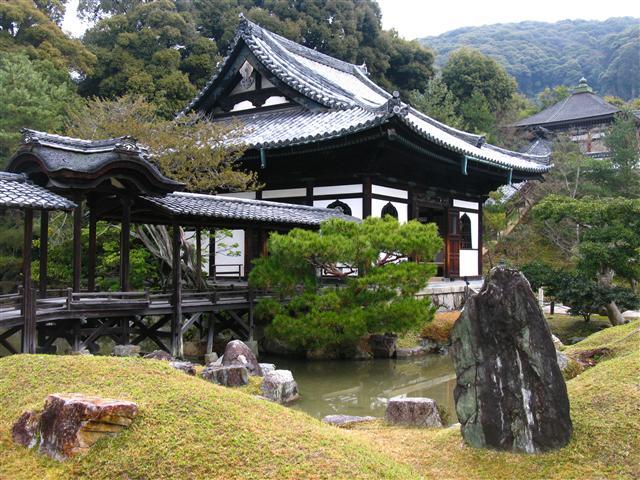


 Part of Kodai-Ji Temple Complex


 Bamboo forest


 Us at Kodai-Ji


Monday, February 18, 2013

Chion-In, Kyoto

There are said to be 1000 Buddhist temples in Kyoto, and it does seem like you glimpse one every time you turn a corner. Yesterday we spent much of the day exploring the vast temple complex of Chion-In, which is the headquarters of the Jodo School, one of the most popular Buddhist sects in Japan. It was founded in 1234, and the oldest of the present buildings date to the 17th century. It's a beautiful and very atmospheric place with chanting monks, burning incense, golden Buddhas, temple bells, cemeteries, gardens, cawing ravens and praying pilgrims.  Not to mention the amazing architecture.

 It was a bright overcast day and quite cold, with light snow showers in the morning, but we were dressed for it. Fortunately, we haven't spent enough time in Hawaii yet to lose our tolerance for cold temperatures. Here in Kyoto we're seeing highs in the 40s and lows in the 30s – not much different than winter temperatures at home in Olympia. And today it rained all day – also not much different than Olympia.


 Chion-In


 Deborah


 Golden Buddha


 Inside one subtemple, looking across at another.


 Zen garden.


 The Main Gate.


 That's me in the hoodie, trying to stay warm.


 Cemetery - We think the ski-like things are some sort of prayer sticks.


 A raven in the cemetery - how appropriate is that?


 Prayer rugs and drums for your chanting pleasure.


 Check out that roof line.


Saturday, February 16, 2013

Konichiwa Japan

You'd think that Hawaii would be a lot closer to Japan than the U.S. mainland – and it is – but it's still a ten hour flight from Honolulu to Osaka. Or, if your plane has a malfunctioning window heater, as ours did, then you get to sit uncomfortably on the plane for an additional three hours as the maintenance crew tries to fix it. The three hour delay caused us to arrive late at night and miss the shuttle I had reserved to take us from Osaka into Kyoto, but the airline arranged for a bus to take us to Kyoto Station and then we were able to hail a cab to take us to our hotel, which we finally stumbled into bleary-eyed at two in the morning.

The hotel is centrally located and really quite nice for the price. They provide a light breakfast and there's a common lounge and kitchenette for guests to use, as well as massage chairs and laundry facilities. The hotel is also spotlessly clean - so much so that I nearly walked through a sliding glass door that was so clear I could have sworn it was open.  Now it has my nose print on it.  Our private bath even has one of those high tech toilets the Japanese are famous for with a heated toilet seat and bidet-like function for those times when toilet paper alone just won't do. I had to try it out, but I wasn't brave enough to set the “fountain” at full throttle. That just seemed wrong.

Our first meal out was at a great little restaurant where you remove your shoes before sitting on a chairless platform on thin cushions in front of a low table. I tried my best to sit cross legged in the local fashion without banging my knees on the underside of the table but, as I know from my yoga practice, I just don't have good hip-opener flexibility. I finally had to settle for a hybrid position where one leg was bent close to my body and the other stuck straight out under the table with its corresponding foot making an appearance at the opposite end where Deborah was seated. She found this quite amusing. The vegetable tempura was delicious and gave us enough energy to do some grocery shopping and to walk about our new temporary neighborhood for a bit. It was just enough of a taste of Kyoto to know we are going to love it here. But I'm too jet-lagged to write any more today.

 Asuka Restaurant, Kyoto


 The food's good, but the furniture is small


 Deborah, ignoring her husband's intruding foot at her side.


 Classic Kyoto architecture


 Vending machines are everywhere


 This strikes me as an unfortunate choice of name for a beverage product


 Control panel for the toilet - not on the space shuttle, but in our hotel room.


Tuesday, February 12, 2013

Timing is Everything

I got a call from the Post Office this morning in response to my recent inquiry about the frustrating absence of our package of winter clothes that we need for our imminent Japan trip. I was told the package would go first to Honolulu on the island of Oahu, then over to Hilo on the opposite side of this island, then to Kamuela (a little bit closer to us), then to our place here in Waikoloa. The result of this circuitous route is a four to six week typical travel time, despite the USPS web site's original assertion that it would only take about two weeks.

So, resigned to the prospect that we didn't have a snow cone's chance in Hilo of receiving the package by Wednesday, we went shopping for clothes. And not wanting to blow our budget on cold weather gear that would seldom get used again in our new Hawaiian lifestyle, we hit the thrift stores first. At the one associated with the Hawi Transfer Station (a nice phrase for “dump”) we got a couple of hoodies, a long sleeve shirt, a stocking cap, and a decorative plate (A what? I know – Deborah can't help herself) for a grand total of $3.25. Then it was over to a church thrift store in Waimea where, with the help of a Valentine's sale, we acquired four long sleeve shirts for me and a funky handmade denim/fleece jacket for Deborah, all for $11. Another Waimea thrift store yielded a couple of pajama bottoms for $7 that Deborah will use as tights. Eleven articles of clothing and a decorative plate for $21. Who says Hawaii is expensive.

Of course, once we arrived back at the Waikoloa house after our shopping odyssey what did we find sitting on the front porch? Our long lost box. The Post Office employee I spoke with this morning gave no indication the package had even made to Hilo yet, let alone that it was on the verge of finally being delivered to our door step, almost exactly one month after it left Olympia. But all our emergency purchases this morning were not a total loss. Deborah loves her funky new jacket and intends to bring it to Japan anyway, plus a couple of the other items. I can say the same for one of the shirts I picked up. And if we ever close on the vacant lot we're trying to buy (we're still waiting) then we'll need work clothes while we're cleaning up the property. Maybe the title company can mirror the post office and perform a similar miracle of perfect timing, bringing our property purchase to a close just before we fly off to Japan. Let's hope.


 Ponds near the Mauna Lani Resort, used for raising fish in a traditional Hawaiian method.


 Similar ponds at Waikoloa Resort.


Deborah models her new jacket.

Saturday, February 9, 2013

The Waiting Game

Our purchase of the vacant lot in Hawi is held up at the title company over the release of an old mortgage on the property. So we wait. We're dying to get up there and start surveying and hacking away at the overgrown bushes and trees, but there's no point until we actually own the property. 

We leave for Japan on February 14th (a nice Valentine's Day present, eh?) so we're hoping this gets resolved before then. We're also hoping the winter clothes being shipped from home get here before we leave. We're going to need them in Japan, where it will be 30 to 40 degrees cooler than here. The clothes were shipped a month ago and have been stuck in Honolulu since January 29th. Apparently they don't send them over to the outer islands until the shipping container is full. So we wait. Tamar has a few things we can borrow for our Japanese winter, but some last minute shopping may be in order if that box doesn't get here soon. Not that Deborah will complain about having to do more clothes shopping, but I will. 

And now for something completely different...

 Gecko on the fruit of a Hala tree


 Another Shabbat, another loaf of challah that's a work of art


 Storm cloud near Waimea


 Clever incorporation of a Honu (Sea Turtle) shape into a rock wall

Wednesday, February 6, 2013

Beware the Vog

Vog is volcanic smog. It's been a continual presence in the Hawaiian Islands since Kilauea started belching particulates, sulfur dioxide, and other gases in 1983. The volcanic gases react in the atmosphere with oxygen, moisture, dust, and sunlight to create unpleasant chemicals that blur the horizon, damage crops and irritate the lungs of the sensitive. Thanks to the prevailing trade winds the east side of the island is normally spared from vog while Kona and the south end get it quite often. It also often blows west over to Maui and Oahu, as if the Big Island – the youngest of the Hawaiian islands – is deliberately farting in the faces of its older siblings.

Vog isn't as brown and ugly as a typical L.A. smog; it's more of a whitish grey haze, but it can do a number on the respiratory systems of some people who are susceptible. We haven't noticed any big effects on ourselves, but then again we haven't seen it too often here in Waikoloa where we're staying. And up in Hawi where we are buying property you really don't see it at all.

Here a few photos from the Hamakua coast on the rainy but normally vog-free east coast:

 Lapahoehoe Point State Park


 Two humans blocking the view of Lapahoehoe Point State Park


 Lots of rain equals lots of green


 Bamboo


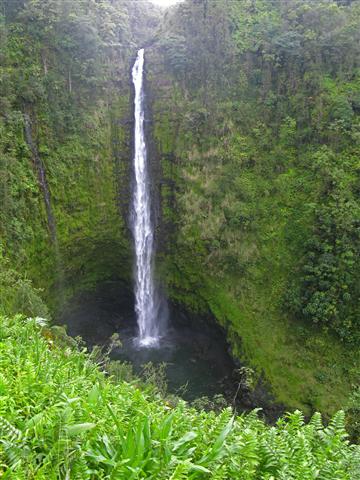
 Akaka Falls


 Believe it or not (I didn't at first) this fish climbs the 442 feet up Akaka Falls.  The secret?  Suction cups!

Saturday, February 2, 2013

Volcano

Hawaii Volcanoes National Park encompasses two active volcanoes: Mauna Loa and Kilauea. Mauna Loa, which last erupted in 1984, is the world's most massive volcano, rising to an elevation of 13,679 ft (neighboring peak Mauna Kea is slightly taller at 13,803 feet, but Mauna Loa is broader and has greater volume). If you measure from either mountain's underwater base rather than from sea level they are taller than Mount Everest.

Kilauea sort of sticks out of the side of Mauna Loa and was once considered part of it, but now is deemed a separate volcano. It is one of the world's most active volcanoes – possibly the most active – having 34 eruptions since 1952, including the most recent event which began in 1983 and has continued to this day. Kilauea is said to be the home of Pele, the Hawaiian volcano goddess. The volcanic glass fibers you find about are known as Pele's hair.

When I was here 18 years ago I could hike right up to the flowing lava on Kilauea's south flank, but now it is much less accessible, unless you spring for a helicopter flight. You can see a bit burbling up in the summit caldera – especially after dark – but hikes around that area are off limits right now due to high levels of sulfur dioxide venting (even though we are probably immune, having already survived high levels of noxious fumes from Tamar's dog the last several weeks). We were at least able to hike around an outer portion of the caldera, where the thin black crust reminds one of the remnants of an oven cleaning cycle and crunches satisfyingly under your feet. Passing from the barren lava fields to the surrounding rainforest makes for a striking contrast. We also walked through a lava tube, which is formed as the outer layers of a subterranean flow cool and harden as the warmer and still molten inner portion flows out, leaving a tubular structure or, as we like to think of it, Pele's colon.

We stayed at a very nice apartment while touring the park, a roomy place in the forest with the use of a hot tub. But the plentiful rain that feeds the lush rainforest surroundings here reinforce our decision to choose instead the more modest rainfall of Hawi. Here in cool, damp Volcano you are constantly fighting towels that won't dry and sofa cushions that smell mildewy. If a place needs a dehumidifier it is not a place we want to live. 

 Steam Vents


 Sulfur Vents


 Kilauea Caldera


 The same - more dramatic at night


 A tourist ponders the gates of hell


 Deborah in the caldera


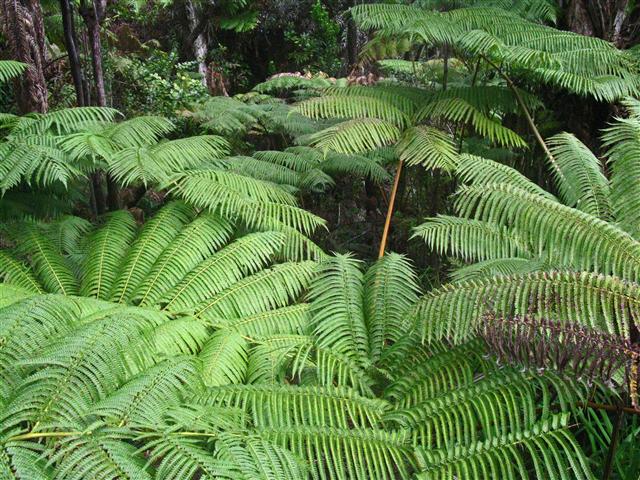
 Ferns find a foothold in the cracks of the caldera floor


 Fern, baby, fern


 Buckled floor of Kilauea Iki Crater


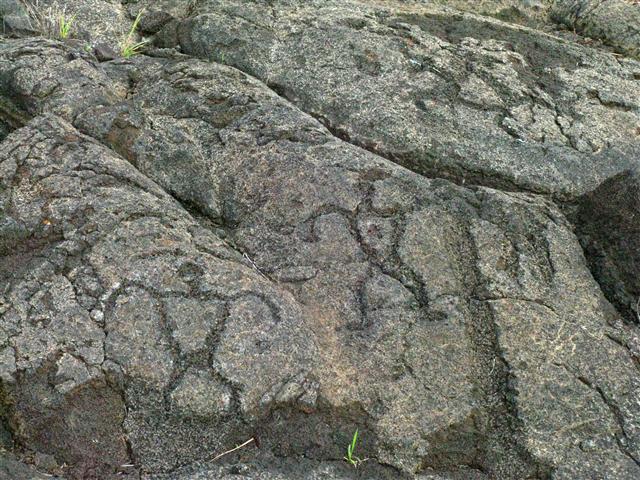
 Petroglyphs